Industry analyst reports on workflow automation ROI cluster in a surprisingly consistent range: first-year returns commonly cited between 200% and 400%, with payback periods of two to nine months depending on the study and the process automated. Those numbers get repeated often enough to sound like a law of nature. They're not — they're an average across a specific kind of automation, and the number that matters for any one business depends heavily on which side of that average it lands on.
The reported savings break down into a few consistent categories across the reports we reviewed: time reclaimed from manual, repetitive tasks; error-correction costs avoided (a wrong entry caught by automation before it becomes a wrong invoice); and reduced per-transaction cost at volume. That last one is where the economics get most concrete — accounts-payable automation figures commonly cited put automated invoice processing at roughly a third of the per-invoice cost of manual processing, purely from removing manual keying and reconciliation.
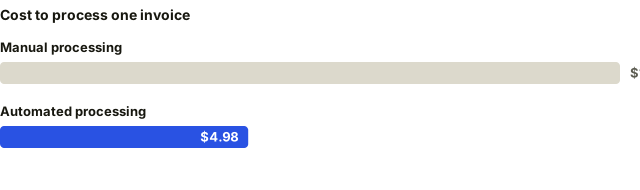
Source: industry accounts-payable benchmarking reports
A 200% ROI and a 400% ROI aren't measuring different quality of automation — they're usually measuring different starting points. A process that was highly manual, error-prone, and high-volume returns dramatically more from automating it than a process that was already lean. The honest takeaway isn't "automation returns 300% on average," it's "automation returns the most exactly where the current process hurts the most" — which is a more useful way to decide what to automate first than chasing an industry-average number.
Most of the ROI research is drawn from mid-size and enterprise deployments, where the automation platform itself is a smaller fraction of total cost. For a small business, licensing and integration cost is a much bigger share of the equation — which is exactly why the emergence of free-to-start, self-hosted automation tools changes the math more than an incremental ROI improvement would. When the tooling cost approaches zero, the same time-and-error savings the enterprise studies report become available at a fraction of the investment, which is the actual economic case for lowering the barrier to entry rather than just improving the automation itself.