We build automation for a living, which means we have a direct stake in this question and no business pretending otherwise. So rather than offer an opinion, this is a review of what the actual labor-economics research says — because the honest answer is more nuanced than either side of the usual argument.
The World Economic Forum's Future of Jobs research projects roughly 92 million existing roles displaced by 2030 against roughly 170 million new roles created — a net positive on paper, but net figures hide the fact that the people displaced and the people newly hired are rarely the same people, in the same place, with the same skills.
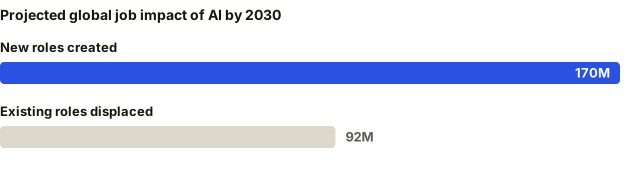
Source: World Economic Forum, Future of Jobs Report
McKinsey's analysis separately estimates that current technology could theoretically automate around 57% of U.S. work hours, while stressing that "theoretically automatable" and "will be automated" are very different claims — most roles are a bundle of tasks, and automating some tasks within a job tends to change the job rather than eliminate it.
Even employer intent skews toward augmentation over replacement in most surveyed sectors. But that average conceals a smaller, real population for whom the outcome is worse than average: research from the National Bureau of Economic Research identifies a specific group — roughly 4% of the U.S. workforce by one estimate — sitting at the intersection of high exposure to AI automation and low ability to move into a different role, concentrated in routine work with few local alternatives. Aggregate statistics that look reassuring at the national level can still describe real hardship concentrated in specific occupations and regions.
The tasks most exposed to automation cluster in routine administrative and processing work — data entry, scheduling, basic document handling, first-line customer inquiries — which is also, not coincidentally, exactly the category of work small business automation tools target first. That overlap is worth sitting with honestly rather than glossing over: the same automation that frees an owner-operator from three hours of manual data entry a day is, in a larger organization, the task a data-entry role used to justify.
The evidence doesn't support "automation is net harmless" any more than it supports "automation is net harmful" — it supports paying attention to who bears the cost of a transition that, in aggregate, looks fine. For a company built on automation tooling, that means being honest about which jobs a given workflow actually removes versus which ones it removes drudgery from, and not hiding behind the comforting version of the statistics when the less comforting version is the one that's true for a specific person's job.